Designing procurement around the value the business needs

At a glance
- Start with business value over the next three to five years. Today’s performance gaps should inform the design without becoming its entire brief.
- Match the service promise with mandate and capacity. Make procurement’s role and the business’s responsibilities explicit.
- Give accountability practical authority. Connect decision rights, delegations and handovers so work has an owner throughout.
- Separate time saved from cost removed. Decide how automation will release capacity and where redeployment can create more value.
- Size the structure around future work. Resource analytics and procurement excellence alongside category and operational delivery.
- Build capability to match the role. Combine targeted development, external recruitment and visible progression pathways.
The brief for procurement is rarely modest. Improve service, generate more value and attract strong talent, while keeping the cost of the function under control. The operating model has to make those expectations achievable.
It is tempting to begin with headcount, reporting lines or the case for centralisation. The starting point, though, is to connect the value the business needs with the services procurement provides, the authority it holds and the capacity it can deploy. Decisions about structure should follow from those choices.
The decisions procurement helps shape have consequences across the business. An inventory decision can release working capital and change supply risk. A sourcing decision can affect the reliability of an operation. The operating model needs to bring those consequences into the same conversation.
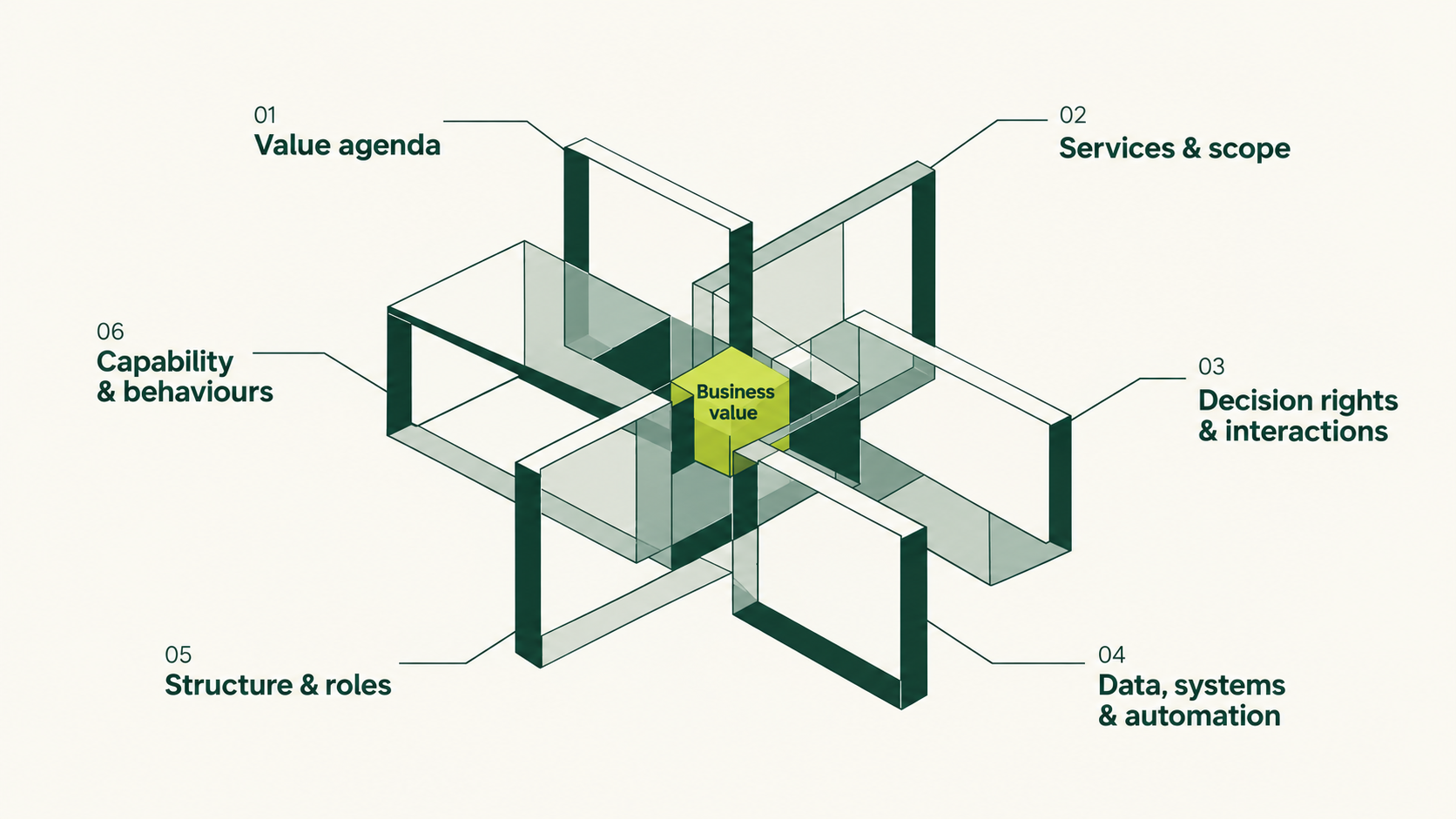
Six elements deserve particular attention. Their sequence helps establish the design, although the choices will need revisiting as costs, demand and practical constraints become clear.
1. What should procurement be known for?
One pattern I have seen is a review that identifies three areas of underperformance, followed by a future model built to fix them. The diagnosis may be sound. The difficulty is allowing today’s problems to become the entire design brief.
By the time the model is implemented and stabilised, the priorities may have shifted. The organisation then finds itself revisiting roles and responsibilities before the previous changes have had time to settle.
A better starting point is to agree what the business will need from procurement over the next three to five years. That might mean supporting a capital programme, improving supply reliability or reducing total cost while releasing working capital. The emphasis should reflect the organisation’s strategy and operating realities.
What should procurement be known for internally? It is a useful question, provided the answer describes a contribution the business values. “Becoming more strategic” offers little guidance for investment. Improving the availability of critical equipment gives the conversation something concrete to work with.
Leadership should agree that value agenda, the measures of success and the trade-offs it is prepared to make. If the business wants more strategic supplier coverage without increasing the cost of the function, what work will be simplified, automated or stopped?
Translate the longer term direction into annual priorities and review it as the business changes. A five-year ambition should provide continuity while leaving room to adapt.
2. “We thought procurement did that”
Few phrases reveal an operating model gap quite as quickly.
During reviews, I have heard stakeholders assign procurement responsibility for areas where the function has neither the mandate nor the capacity to deliver. The expectation is real, even though the service has never been properly agreed or resourced.
Once the value agenda is clear, define the service offer. Be explicit about where procurement leads, where it supports and where another part of the business owns the work. Agree the level of service too. A strategic supplier relationship and a routine purchase should not automatically attract the same attention.
Contract management and supplier relationship management are particularly important here. Procurement may establish the frameworks, support complex commercial issues and help manage selected strategic relationships. The business still needs named owners to manage performance, resolve issues and work with suppliers on improvement.
Consider a maintenance contract. A category manager can negotiate strong commercial terms, but the operating team still needs to plan the work, supervise delivery and confirm that the service meets requirements. If no one owns those activities, lower rates can be offset by unplanned call-outs or repeat work. The model needs to connect the commercial agreement to operational delivery and the value actually realised. Writing “shared responsibility” beside contract management leaves too much unresolved unless those obligations are assigned.
Leadership agreement must reach the people using the model. A site supervisor, contract owner or project manager should know when to involve procurement, what support to expect and which decisions remain theirs. Otherwise, the service boundary exists in a document while expectations continue to be set informally.
3. Who gets to make the call?
Giving a team greater responsibility without the authority to influence outcomes is a quick route to frustration. People are held accountable for results while the decisions that shape them are made elsewhere.
A RASCI can help clarify who is responsible, accountable, supporting, consulted and informed. It needs to align with actual delegations, approval thresholds and escalation routes. A letter in a matrix does not grant authority to decide.
For a supplier selection, distinguish who makes the commercial recommendation, who confirms operational suitability and who has authority to approve the commitment. Where procurement cannot make the final call, establish how its advice enters the decision and how unresolved concerns are escalated.
The interaction model matters just as much. Follow a contract from award into mobilisation, performance management and renewal. At each handover, someone needs to accept ownership, receive the necessary information and understand the next action. That is how the model addresses the gaps behind “I thought someone else was doing it”.
Committees also need a clear remit. Which decisions belong in the room, which can be delegated and when does an issue need to move upwards? Repeatedly taking the same matter through several forums can consume capacity without adding useful scrutiny.
The aim is a model in which people can exercise judgement within clear boundaries and the business knows who will act.
4. What happens to the work when we automate it?
“Will AI reduce the size of the team?” is a fair question. Answering it requires a clear view of the work being changed.
Start with the process and its data. Identify the tasks that could be removed, simplified or supported by technology, along with the judgement and exceptions that remain. A workflow that still requires missing information to be chased and outputs to be reworked may release less capacity than its business case assumes.
Then compare the delivery options on a consistent basis. Onshore teams, offshore services, automation and combinations of these should be assessed against the same scope, service level and quality requirements. An offshore salary and an AI token price are only fragments of that comparison.
The economics need to include implementation, integration, data preparation, licences or usage charges, human review, exception handling and ongoing support. Test the assumptions on representative work before building the future team around the forecast.
Be equally precise about the benefit. Time released from tasks, capacity available for other work and cost that can be removed are different outcomes. Small time savings spread across several roles do not automatically create a position that can be taken out.
In some cases, the stronger choice will be to put that capacity into category strategy or supplier relationships that have received too little attention. The role mix and skills required may change even where total headcount stays the same. Make the redeployment explicit, including the capability people will need and the additional value expected. Otherwise, the time can disappear back into the daily workload.
Set the guardrails at the same time: what data may be used, who can access it, which outputs need checking and which commitments require human approval. Assign accountability for the process and retain a record of consequential decisions.
5. Now draw the organisation chart
With these choices visible, structure becomes a resourcing decision grounded in the work ahead.
Look at future demand: the categories in scope, strategic suppliers and contracts requiring active management, sourcing workload and transaction volumes. Add complexity, risk, geography and peaks in demand. Spend alone is too blunt a basis for deciding how many people are needed.
Determine where the work should sit. Central category leadership can coexist with local operational ownership. Repeatable activity may suit shared services or offshore delivery, while work requiring close involvement with operations needs access to the people making those decisions.
Benchmarking can test the design, provided the comparison reflects what each function actually does.
One recurring gap I have seen is underinvestment in procurement excellence and analytics. If category managers spend their time reconciling data, maintaining workarounds and resolving process issues, that effort comes out of the capacity available for category strategy. Better reporting will be difficult to sustain without ownership of the underlying data. A recurring process bottleneck also needs someone with the time and remit to fix it.
Protect capacity for improving processes, systems and data, and for translating information into commercial insight. This does not require every organisation to establish a separate centre of excellence. It does require clear ownership and realistic resourcing, whether through dedicated roles or shared capability.
The investment case should recognise the effect on the wider team. Reliable insight helps category managers make better choices. Simpler processes can improve service while retaining appropriate controls. A lean procurement function can become expensive for the business if its design leaves those needs unattended.
6. Give people a fair chance to succeed
A new position description can change expectations overnight. The person appointed to the role needs a credible way to meet them.
A common trap is to shape the role around an incumbent, or assume that a new title will produce a new capability. Start by defining the outcomes, skills and behaviours the role requires. Then assess the existing team against those requirements, including their potential to develop.
This is where organisational knowledge deserves proper weight. People who understand the business, its operations and its stakeholders bring something valuable. An honest assessment should identify how that knowledge can be combined with the capabilities the future model needs.
Build a practical development plan around the gaps. A twelve-month pathway, with clear milestones, can give someone room to grow through coaching and real assignments. Developing a category strategy or leading a supplier review with support can make progress visible. Be realistic about which gaps can be closed within the required timeframe, and recruit where additional capability is needed.
Be specific about behaviours too. Earlier engagement with stakeholders, constructive challenge and reliable follow-through across handovers need to be part of everyday expectations. Leaders should recognise those behaviours and assess the contribution people make through them.
Finally, make progression visible. Give high performers a route into broader responsibility or deeper commercial and analytical expertise, and plan who could step into critical roles over time. Existing employees and prospective hires should be able to see meaningful work, appropriate authority and a future in the function.
Making the model work
The model still needs a funded route into operation. Agree executive sponsorship, transition priorities and ownership of the changes. Sequence them so that new services, systems and capabilities are in place when the business is expected to rely on them. Someone also needs the capacity to lead the transition while daily work continues.
Measure progress against the original value agenda. Agree baselines, benefit owners and success measures with finance and operational leaders, covering realised commercial benefits, service performance and the function’s cost to serve. Track whether decisions improve and whether the team can sustain its new responsibilities. Review the design when the evidence warrants it.
At Krish, we see these as connected choices, shaped with the people who will make them work. The test for leadership is practical: can the services, decision rights, resources and capabilities in this model support the value we are asking procurement to deliver? That is the question to resolve before approving the organisation chart.


Stay informed. Stay ahead.
Our latest thinking, delivered to your inbox.